

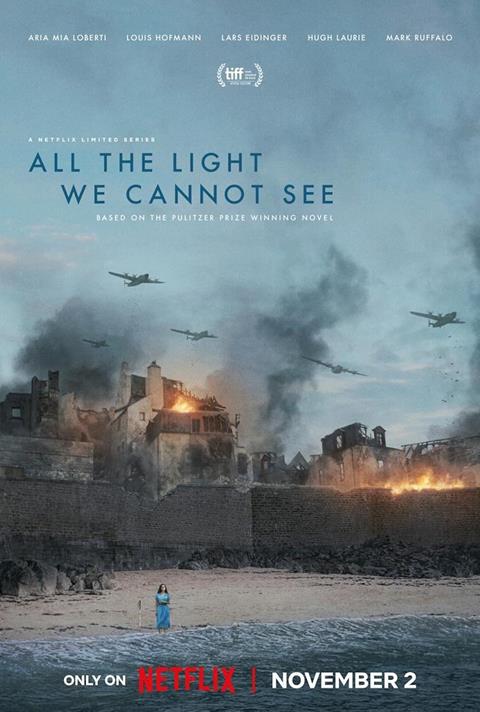
All the Light We Cannot See was the latest offering on Netflix at Christmas, based on the Pulitzer Prize-winning novel by Anthony Doerr.
Christmas, even in a hemisphere of long summer evenings of daylight savings, is all about light. Light is magical against the darkness - we drive around suburbs spotting the houses with the most Christmas lights. We ooh and ahh as we flick the switch on our Christmas tree. Last week, the Jewish festival of Hanukkah commenced. This is essentially a festival of lights based around the lighting of candles. Ironically it begins as Israel & Palestine reach new depths of a dark & frightening war. Light has a magical quality for human beings, we are drawn to the light - and it doesn’t take much light to dispel the pitch darkness.
All the Light We Cannot See is the latest offering on Netflix this Christmas, based on the Pulitzer Prize-winning novel by Anthony Doerr. I read the book years ago and it was a gripping page-turner. I was sceptical about how a miniseries could do justice to such an amazing read. This is a captivating series that delivers in spades. IT IS HAUNTINGLY beautiful. Against the backdrop of Nazi-occupied France, it weaves the story of two young people: Marie-Laure Blanc and Werner Pfennig whose lives eventually collide on the west coast of France at the height of the Allied bombing. Marie-Laure has fled Paris with her father, the curator of the Paris Museum, to stay with her Uncle Etienne who lives in St Malo, a small medieval village on the French coast. Marie-Laure and her father’s journey is made even more difficult because Marie is blind, totally blind. As the world literally darkens with the German invasion, Marie sees what is invisible to most of the other characters. She perceives the kindness of people like those desperately trying to send coded messages to the Allies over the radio waves. She also perceives the murky darkness of the Nazi regime epitomised in those pursuing her father and eventually her.
At the same time, a young German orphan, Werner, with extraordinary technical skills in transmitter radios, is fast-tracked through an elite Hitler youth training school. He finds himself conflicted by an ideology to which he cannot subscribe and yet at the same time must comply with or die. Both young people as children, were shaped by a professor broadcasting on the airwaves. They remember him saying,
“The brain is locked in total darkness, without a spark of light and yet it builds for us a world full of light.”
This is a great series to contrast and compare with the opening chapters of John’s gospel an equally fascinating play on the human response to God’s light and the world’s darkness.
“In him was life, and that life was the light of all humankind. The light shines in the darkness, and the darkness has not overcome it.” (John 1:4-5). Jesus later pronounces of himself, “While I am in the world, I am the light of the world.” (John 9:5). Further on he explains the purpose of his journey into our world: “I have come into the world as a light, so that no one who believes in me should stay in darkness.” (John 12:46).
Christmas can be understood as God piercing our dark, dark world with ‘love’s pure light’ - Jesus. John’s gospel shows how that light is embraced by some, uncomfortable for others and met with downright hostility by those who attempt to snuff out the light altogether. It is the story of all the light we cannot see - the light from light eternal. Maybe there is light shed this Christmas that previously we could not see? Can a spiritually blind person begin to perceive all the light of God previously veiled for them? The Christmas story says “YES!” Have you that optimism for your work friends or family this Christmas? God does!
The carol O Come O Come Emmanuel captures that hope:
O come, O Bright and Morning Star,
and bring us comfort from afar!
Dispel the shadows of the night
and turn our darkness into light.
Watch the teaser for All the light we cannot see, here.
